The ‘Distance Decay’ Error That Shrank Your Chicago Map Radius Overnight
Imagine this: You’ve spent years building your business in the West Loop. You’ve gathered hundreds of five-star reviews, optimized your website, and for a long time, you were the undisputed king of the local map pack. Whether someone searched from River North, the South Loop, or even as far out as Logan Square, your pin was there – front and center. Then, seemingly overnight in early 2026, the floor fell out. You’re still ranking #1 if someone stands in your lobby, but the moment they cross the Kennedy Expressway or head north past Grand Avenue, you vanish. You haven’t been penalized; you’ve been hit by Distance Decay.
As a Google Product Expert with over 19 years of experience – having optimized over 10,000 listings and worked with iconic Chicago brands like the Chicago Cubs – I have seen every algorithmic shift Google has thrown at us. But the 2026 “Proximity Trap” is different. It is a fundamental tightening of the local search radius that prioritizes physical proximity over established authority. This phenomenon is shrinking the reach of Chicago businesses, turning “city-wide” dominance into “block-by-block” survival.
In this guide, I’m going to break down why this is happening, the data behind the shift, and how you can use Fix Your Shrinking Local Pack Chicago Radius: 3 2026 Hacks to reclaim your territory across the Windy City. We will explore the three pillars of local search – Proximity, Relevance, and Prominence – and how the balance between them has been disrupted.
II. The Proximity Trap: Why Your Radius Shrank in 2026
The “Proximity Trap” is the result of Google’s increasingly aggressive stance on hyper-local intent. In the past, a high “Prominence” score (backlinks, reviews, and brand mentions) could overcome a lack of “Proximity.” You could rank in Wicker Park even if your office was in the Loop because Google trusted your brand more than the smaller shop next door to the user. In 2026, that buffer has largely evaporated.
This shift is driven by two major factors. First, the “Near Me” filter has become the default behavior for the algorithm. Google’s mobile-first indexing now assumes that if a user is looking for a service, they want the absolute closest option, even if that option has fewer reviews or a weaker website. This creates what we call “parking lot ranking” – where you only appear in the top three results when the user is literally standing in your parking lot.
Second, the monetization of the local pack has reached an all-time high. According to data from PPC Land, Google’s local pack ads surged from less than 3% to 22% of tracked mobile keywords between late 2025 and early 2026. This 733% increase in local pack ads means that organic space is at a premium. When Google shrinks the organic radius, it forces businesses to bid on Local Services Ads (LSAs) to reach customers just two miles away. To fight back, many businesses are turning to a professional google maps ranking service to find the technical gaps that the proximity filter is exploiting.
If you don’t address this, you are essentially letting Google dictate that your business only exists within a half-mile radius. You can’t afford to Stop Letting the Chicago Proximity Trap Kill Your Map Leads any longer; you need to understand that the algorithm is now biased toward the “hyper-local” at the expense of the “authoritative.”
III. The “After-Hours” Ghosting Effect
One of the most frustrating aspects of the 2026 algorithm is the “After-Hours Ghosting Effect.” Our research into thousands of Chicago-based Google Business Profiles (GBPs) has revealed a startling trend: listings are frequently dropped from the Map Pack the minute the business marks itself as “Closed.”
Google’s logic is simple but flawed for service-based businesses: if a user is searching for a plumber at 8:00 PM, they likely need one now. Consequently, Google filters out businesses that aren’t currently open, even if they are the most qualified. For a law firm in the Daley Center or a med spa in Gold Coast, this can result in a massive loss of lead flow during evening hours when consumers are doing their research.
To mitigate this, you must rethink your “Service Area” settings and your stated hours. If you have an answering service or 24/7 intake, your profile should reflect that capability. However, simply changing your hours to “24 Hours” without the infrastructure to back it up can lead to user complaints and “suggested edits” that damage your ranking. This is The Small Tweak That Stops Your Chicago Map Pin from Vanishing at Night. You must align your digital availability with Google’s real-time filtering to maintain visibility while your competitors “ghost” the map every evening.
IV. Breaking the Radius: 4 Tactics to Expand Your Reach
While proximity is a “hard” factor (you can’t move your building closer to every customer), relevance and prominence are “soft” factors that can be amplified to “break” the proximity filter. Here are four technical tactics to expand your Chicago map radius:
1. Neighborhood Interaction Signals
Google tracks where your users are coming from. If 90% of your website traffic and click-throughs come from the West Loop, Google will categorize you as a West Loop-only business. To expand, you need interaction signals from other zip codes. This can be achieved through localized social media ad campaigns targeting specific neighborhoods like Bucktown or Bridgeport. When users in those areas click your “Directions” or “Call” button, it signals to Google that you are relevant to that specific geography, regardless of the physical distance.
2. Hyperlocal Content and Landmarks
Stop using generic “Chicago SEO” terms. To rank across the city, your website and GBP updates must reference hyperlocal landmarks. If you are a contractor serving the North Side, mention your proximity to the Addison Red Line station or your recent project “three blocks from Wrigley Field.” This creates a semantic link between your business entity and those specific geographic coordinates. Using local seo tools can help you identify which neighborhood keywords have the highest intent and lowest competition.
3. Photo Metadata & Geo-signals
Visual proof is a major ranking signal in 2026. When you perform a service in Hyde Park or Lincoln Square, take a photo and upload it to your Google Business Profile. While Google officially strips EXIF data for privacy, the AI vision algorithm can identify landmarks, street signs, and even the unique architecture of Chicago neighborhoods. This provides “visual evidence” to the algorithm that your business is active outside of your immediate office radius. This is one of the essential 4 Tactics to Expand Your Chicago Map Radius in 2026.
4. Local Authority Building
Generic backlinks from national blogs do very little for your Map Pack ranking. You need “Local Authority.” A link from a neighborhood association in Lakeview or a mention in a “Best of Logan Square” list carries significantly more weight in the local algorithm than a high-DA link from a generic marketing site. Google is looking for “Entity Authority” – proof that your business is a pillar of the Chicago community.
V. The Role of AI Overviews and 2026 Algorithm Shifts
The introduction of AI Overviews (formerly SGE) has fundamentally changed the “real estate” of the Search Engine Results Page (SERP). In many local queries, the AI Overview now appears above the traditional Map Pack. This AI doesn’t just look at distance; it looks at “Entity Relevance.”
The AI synthesizes information from your website, your reviews, and third-party mentions to determine if you are the best answer to a user’s specific problem. For example, if a user searches for “best divorce lawyer for high-net-worth individuals near me,” the AI might bypass the closest lawyer to recommend one five miles away who has specific mentions of “high-net-worth” and “asset protection” in their reviews and site content. To stay ahead, you must implement 5 Tactics to Beat AI Overviews in the Chicago Local Pack [2026], focusing on long-tail keyword relevance and semantic depth.
VI. Audit & Automation: Using the Right Stack
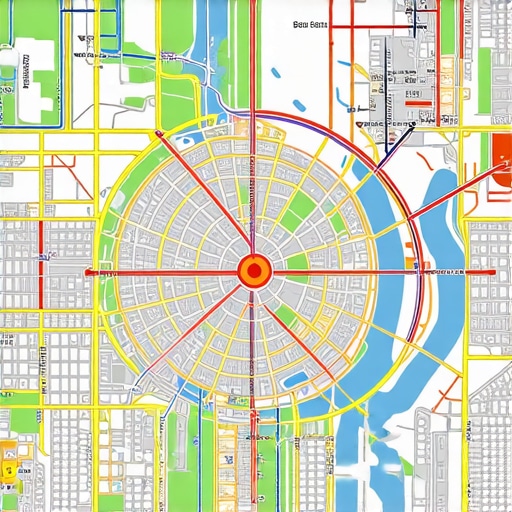
You cannot fix what you cannot measure. Most business owners look at their rankings from their office computer and assume they are doing fine. This is a mistake. Because of Distance Decay, your rankings change every few blocks. You need a comprehensive “heat map” of your visibility across Chicago.
To truly understand the “Distance Decay” affecting your business, you need professional local seo software. These tools allow you to run a grid search across the city, showing exactly where your pin drops from #3 to #4 (the “cliff of invisibility”). By using a **google business profile audit tool** and a **google maps rank tracker**, you can identify the specific neighborhoods where your “Relevance” is failing to overcome the “Proximity” filter. This data-driven approach is the only way to manage a multi-location or service-area business in the competitive Chicago market.
VII. Conclusion & CTA
Distance Decay is a “hard” algorithmic constraint, but it isn’t an insurmountable one. While Google’s 2026 updates have made proximity a dominant factor, the pillars of Relevance and Prominence remain the levers you can pull to expand your reach. By focusing on hyperlocal content, neighborhood-specific interaction signals, and maintaining a robust digital presence through “Open Now” filters, you can break the Proximity Trap and reclaim your Chicago map radius.
Don’t let your business be confined to a single city block. If you’re seeing your leads dry up as your map pin vanishes, it’s time for a technical intervention. Perform a local audit today, or reach out to me, Antoine Cameron, for a deep-dive strategy session to restore your dominance in the Chicago Local Pack.